
Stop Using Your Phone Light: The Complete EDC Flashlight Guide
**Written by Juan Arango**
Former Colombian Army Infantry Officer | 7+ Years Combat Experience
In an unexpected moment of darkness, most people instinctively reach for their phone. But a smartphone light is often a poor substitute for a purpose-built tool.
A smartphone’s low-powered beam provides limited visibility, and its fragile design means a single drop can leave you without light and a means of communication. This is precisely why a dedicated, reliable flashlight is a non-negotiable tool for the Prepared & Practical Everyday Carrier. It’s not just for emergencies; it’s for taking control of the situations you encounter every day with rugged, dependable gear that won’t fail you.
Core Components: The Anatomy of a High-Performance Light
A flashlight is only useful if it's on you when you need it. This is why portability and usability are critical. An EDC light must be compact and lightweight, designed to disappear into a pocket or clip discreetly onto a belt. It needs a simple, intuitive user interface, allowing for quick, straightforward activation without fumbling in the dark. The seconds you save with a practical tool can make all the difference.
Next, let's talk about lumens, which is just a technical term for how much light your flashlight puts out. You'll see flashlights boasting thousands of lumens, but for an EDC light, more isn't always better. A good everyday light should have a practical range that can handle various tasks. For navigating a dark hallway or finding something you dropped in your car, a lower output of around 100-200 lumens is more than enough. When you need to check a fence line or illuminate a wide area, you'll want something in the 500-1000 lumen range. A 2,000-lumen output is a powerful tool, providing a "turbo" mode for specific situations like scanning a field for potential threats or locating something at a great distance. The key is versatility—you need a light with different modes so you can choose the right amount of light for the job without blinding yourself or wasting battery.
Beyond just lumens, the beam pattern is crucial. A light's beam is generally a combination of two types: throw and flood. A "throw" beam is a tight, focused column of light designed to cut through the darkness and reach distant objects. Think of it as a laser beam, ideal for spotting something across a field or down a long alley. In contrast, a "flood" beam is a wide, dispersed cone of light that illuminates a broad area at close range, like a car headlight or a light bulb. It's your go-to for tasks like searching a room or working under the hood of a car. The best EDC flashlights don't just specialize in one. They are engineered to provide a balanced beam. This balanced approach gives you a bright "hotspot" for seeing at a distance, while also providing a softer, wider "spill" of light to illuminate your immediate surroundings and avoid tripping over obstacles.
Finally, a tool is only as good as its construction, which brings us to durability and reliability. A quality EDC flashlight is a piece of gear, not a fragile gadget. Look for lights constructed from robust materials like anodized aluminum. This material isn’t just for aesthetics—it’s built to withstand being dropped, knocked around, and generally abused in the real world. Additionally, check for the Ingress Protection (IPX) rating, which tells you how resistant a light is to water and dust. For a reliable EDC light, an IPX7 or IPX8 rating is what you should look for. An IPX7 rating means the light can be submerged in water up to 1 meter for 30 minutes, while an IPX8 rating protects it during continuous submersion. These ratings ensure your flashlight will perform in the rain, through splashes, or if it takes an unexpected dip in a puddle.
Choosing a power source for your flashlight is a matter of practical trade-offs. You'll generally be choosing between disposable batteries like AA or AAA, and rechargeable batteries, most often lithium-ion. Disposable batteries are easy to find and can be swapped out in a pinch, but they're a consistent, long-term expense and create more waste. Rechargeable lithium-ion batteries, while more expensive initially, are more convenient and cost-effective over time because you won't need to buy replacements. They also offer better performance, holding a charge longer and delivering higher output for more demanding tasks. A good EDC flashlight will often use a rechargeable battery as its primary power source, with some models offering a secondary option for disposable batteries.
Our Curated Flashlights
We don't sell every light; we sell the right lights. Each of the flashlights below has been selected for its proven performance, durability, and practical design, reflecting the same no-nonsense criteria we apply to all our gear.
Nitecore EDC29: This isn't just a light; it's a high-performance tool in a slim package. With an output of up to 6,500 lumens, the EDC29 provides a powerful "turbo" mode for identifying distant targets or quickly illuminating a large space. Its anti-slip texture and dual tail switches ensure a secure grip and intuitive operation, while the built-in rechargeable lithium-ion battery and USB-C port make for a convenient and reliable power source. The IP54 rating means it can handle dust and splashes, making it a rugged, dependable choice for daily carry.
→ [Shop the Nitecore EDC29 ($80.00)]
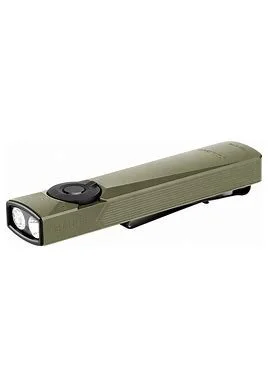
Olight Arkfeld Pro: This light is the definition of versatility. Its unique, flat rectangular design is exceptionally comfortable for pocket carry, ensuring it's never left behind. The Arkfeld Pro offers a powerful white LED with multiple output modes, a UV light for inspections, and a green laser pointer, all accessible via an intuitive selector dial. With an IPX7 water-resistant rating, it's a tough, no-compromise tool that will perform in various environments and situations. Its built-in rechargeable battery and magnetic charging system provide a seamless and convenient power solution.
→ [Shop the Olight Arkfeld Pro ($85.00)]
Olight Odin Mini Tactical Flashlight: Purpose-built for serious application, the Odin Mini is a compact tactical light that delivers uncompromising performance. Designed to be rail-mounted with a quick-detach system, it provides a powerful 1,250-lumen output and a focused beam with a 240-meter throw for positive target identification at a distance. Its IPX8 waterproof rating and rugged aluminum alloy body ensure it can withstand the harshest conditions. The magnetic charging cable and included remote pressure switch make it a complete, reliable system for tactical use.
→ [Shop the Olight Odin Mini ($115.00)]
Quick Comparison
| Model | Max Lumens | IPX Rating | Price | Best For |
|---|---|---|---|---|
| EDC29 | 6,500 | IP54 | $80 | Maximum output |
| Arkfeld Pro | 1,300 | IPX7 | $85 | 3-in-1 versatility |
| Odin Mini | 1,250 | IPX8 | $115 | Tactical mounting |
━━━━━━━━━━━━━━━━━━━━━━━━━━━━━━━━━━━━━━━━━━━━━━━━━
Frequently Asked Questions
What's the best EDC flashlight for everyday carry?
The Olight Arkfeld Pro is our top recommendation for most users. It combines a powerful 1,300-lumen white light with UV and green laser functionality, all in a flat, pocketable design with IPX7 water resistance.
How many lumens do I actually need?
For everyday tasks like navigating dark areas or finding items, 300-1,000 lumens is ideal. Higher outputs (2,000+ lumens) are useful for specific situations but drain batteries faster.
Are rechargeable flashlights better than disposable batteries?
Yes, for EDC use. Rechargeable lithium-ion batteries are more convenient, cost-effective long-term, and deliver consistent high performance. Look for USB-C charging for maximum versatility.
What does IPX7 mean?
An IPX7 rating means the light can be submerged in 1 meter of water for 30 minutes without damage. This protects against rain, splashes, and accidental drops in water.
Why not just use my phone's flashlight?
Phone lights typically output only 50-100 lumens, drain your battery quickly, and risk damaging your primary communication device. A dedicated EDC flashlight is brighter, more durable, and keeps your phone available for emergencies.
Conclusion: Your Beacon of Readiness
The right flashlight is more than a gadget; it’s a non-negotiable part of your everyday preparedness. It’s a piece of gear that has been chosen for durability, reliability, and practical performance. Don’t let a dead phone battery or a flimsy light leave you in the dark. Your readiness depends on having the right tool for the job.
Ready to upgrade your EDC?
Shop Our Curated Flashlight Collection →
Questions? Email juan@sftgear.com - I personally respond to every message.